
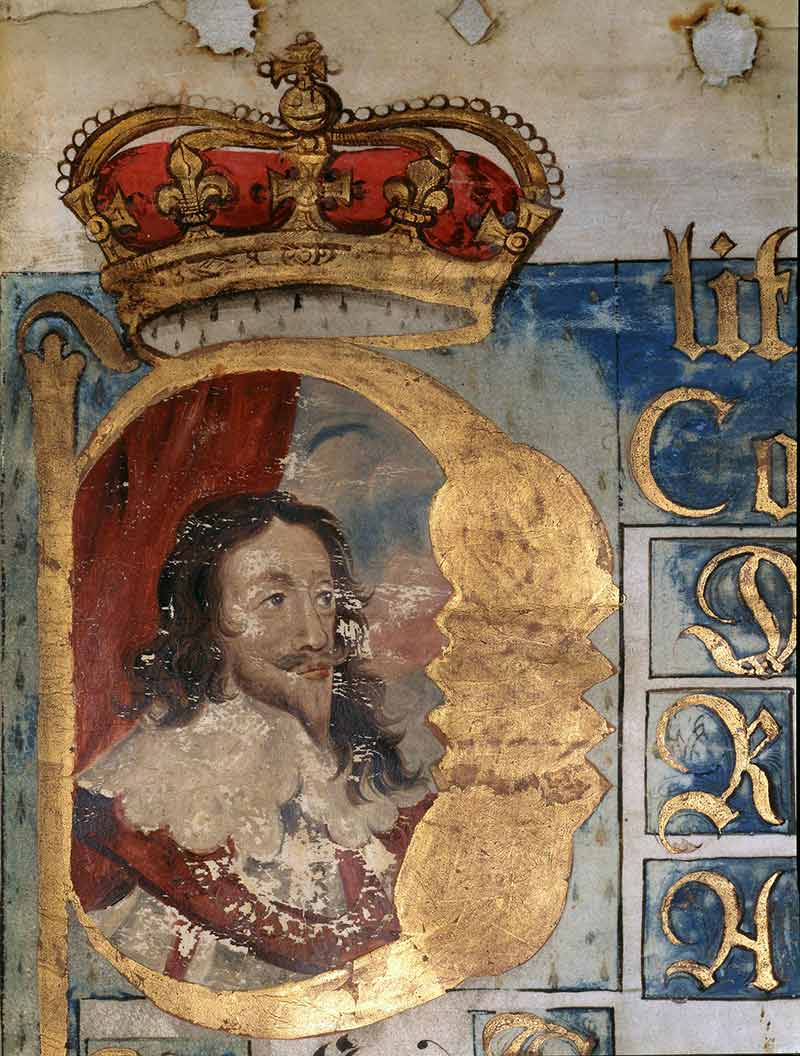
For 11 years, (1629-1640) Charles raised money without Parliament. The most nefarious end run around the Magna Carta and the Petition of Right – Ship’s Money – produced the greatest Constitutional resistance. Traditionally, during a wartime emergency, the King could require seaports to supply ships for defense of the realm. Everyone agreed that Queen Elizabeth in 1588 had unquestionably exercised Executive prerogative wisely. In this real emergency she did what needed to be done, defeating the Spanish Armada and saving the Kingdom.
But Charles declared an emergency where obviously there was none. The next year he insisted the emergency continued and demanded ships from subjects in inland towns – who had never so much as seen the water. No matter. If they couldn’t supply ships, they could fork over the monetary equivalent. When the King repeated this demand for a third year, the pattern was clear: Ships’ Money was becoming a permanent non-Parliamentary tax. Leading individuals refused to pay their assessment, and as defendants, challenged Ships’ Money before a High Court of 12 judges, specially convened to consider and hopefully settle once and for all, the Constitutional conflict between the Executive and Legislature.
“This was “the greatest case that ever came in the memory of any man,” the lawyers and judges all agreed. “On the one side it concerneth the King in his prerogative and power royal; and on the other side it concerneth all the King’s subjects in their liberties,” setting off Constitutionally, Power vs. Liberty – Executive vs. the Legislature.
Lawyers, judges and debaters of all stripes have long known that how you state the question often determines the answer. The question came down to this, the King’s Attorney General insisted: “Whether the King where he in his royal judgement shall conceive a necessity for the defence of the realm may command ships” or their monetary equivalent “or must [he] require the aid in parliament?” Defense Counsel, of course, phrased the question very differently: “That though there be no actual invasion, no known or declared enemy; yet the King. . apprehendeth and forseeth danger . . so instant and unavoidable – whether the King (with)out Parliament by his royal power can command this supply?”
Everyone conceded the King’s transcendent right and responsibility to save the Kingdom. Of course “the safety of the people is the supreme law.” In the clear case of actual invasion, “of instant and apparent danger”, that “instinct” for self-preservation would and should prevail. But what if the King mistakenly believes there is an emergency where in fact there is none? Worse, what if the King lies and claims an emergency where he – and most everybody else – knows there is none? Royal apologists had long insisted that as God’s lieutenant, the King could do no wrong. In that case, declared Justice Crooke bravely, if it’s wrong then the King hasn’t done it. Instead, consider it “a matter done upon an untrue suggestion.” Blame his advisors. That move had a long history ahead of it in England and America.
“Leaving the king to judge of the necessity” the defense had insisted, is all the same “as to leave it to him arbitrarily.” When it came time to decide this case, however, the majority was pragmatic: “The King is sole judge of the danger,” declared the Chief Justice, or “else it should [only] be danger, but when every one shall say.” “Somebody must do it, and who better than the king?” declared Justice Weston. “Make what laws you will, if the king be unruly he will break through them.” In the end, the highest court in this, the greatest Constitutional case in English history, in several opinions that run nearly 400 pages, split 7-5 for the King.
“This Judgment,” declared the editor of the volume in which the case appeared, “gave much offence to the nation.” The Ship’s money itself “was borne with much more cheerfulness before the Judgement for the King than ever it was after.” When opponents heard that “instead of giving, they were required to pay, and by a logic that left no man anything which he might call his own, they no more looked upon it as the case of one man, but the case of the kingdom.”
In sum, it was only 20 shillings, but the Constitutional logic by which the King had in theory an unlimited right to decide and act upon Executive prerogative, eventually cost Charles I not only his crown, but also his head on which it rested.
 Father Anonymous
Leave a comment