
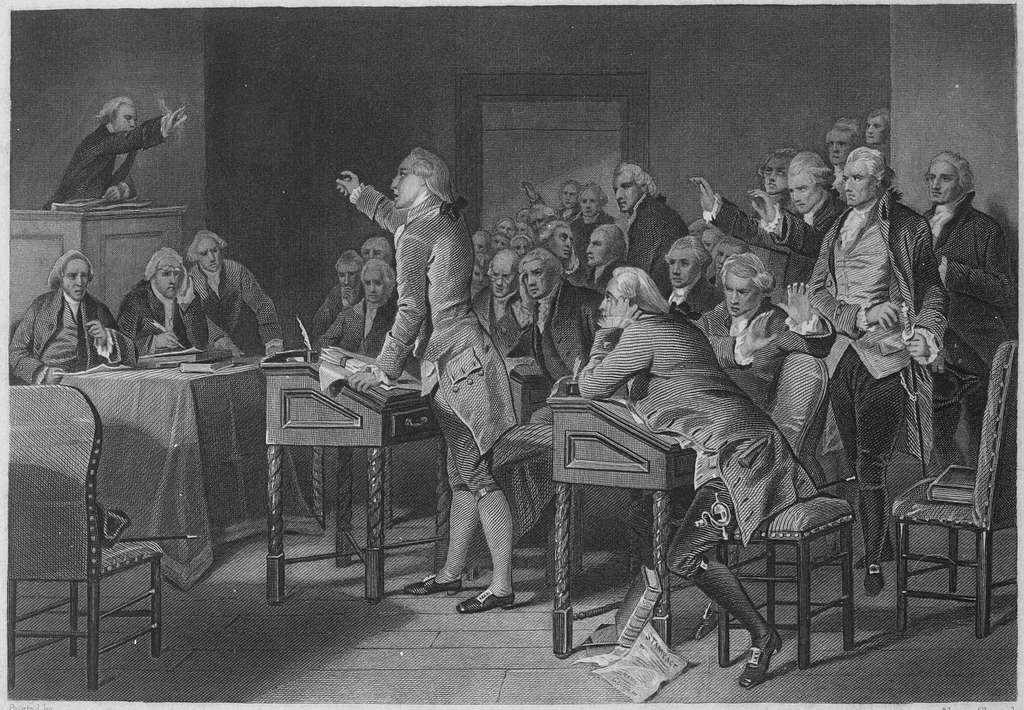
The British American colonies ranged widely in their legal structure and degree of authority that the King, Privy Council, Board of Trade and Secretary of State in London actually exercised from afar. The two most autonomous American colonies, Connecticut and Rhode Island, chose their own Governors and largely controlled their own internal affairs. But every colony, however dependent on London, had their own locally elected assembly. Although the American colonies did not send elected representatives to Parliament, they did have paid agents in London to represent their interests and keep them informed.
In the decades following the Glorious Revolution of 1688, England and the colonies diverged in basic Constitutional outlook. The English smugly believed they had found a perfect blend of Monarchy, Aristocracy and Democracy. Ultimately, in theory, Parliament had supreme sovereignty and could do no wrong. The American colonists considered themselves Englishmen entitled to all fundamental English rights and liberties. In sum, English Constitutionalists largely saw the Glorious Revolution as having settled once and for all the Constitutional structure of the British empire. But in America, leading elements looked to John Locke’s ideology of popular sovereignty and a transcendent right to Revolution for their Constitutional teachings.
Most every colonial assembly had drafted its own statement of fundamental liberties, committing itself to Magna Carta. But the King retained a right to veto acts of American legislatures long after he lost it over Parliament. Parliament controlled foreign and Indian affairs; it restricted and coordinated colonial trade and commerce for the good of the British Empire. But while American colonists mostly acknowledged the superintending authority of King-in-Parliament, by smuggling, evasion, and delay, they could effectively nullify efforts by the central government in London to superintend local day-to-day life. If, after the Glorious Revolution, in official Constitutional theory Parliament was supreme, in practice in America by mid-18th Century this supreme power encroached very little upon internal day-to-day American affairs.
 Father Anonymous
Leave a comment