
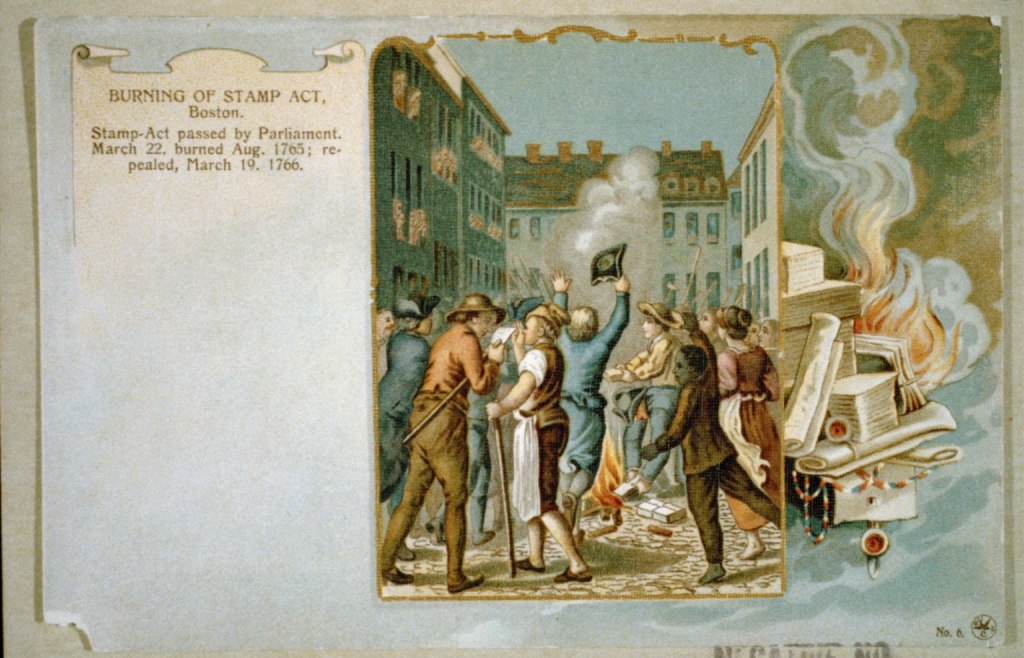
The American Revolution, John Adams declared, was fought “in the hearts and minds” of Americans 10 years before the first shot was fired at Lexington and Concord. He was referring to the Stamp Act Crisis.
In 1763, Britain and France ended their Seven Years War, a world war which swelled the British Empire but depleted its treasury. Americans had done their part fighting in the North American phase, the French and Indian War. But the British Administration stationed 10,000 troops at strategic American frontier outposts to prevent the French, Spanish or Indian from regaining lost territory. The War had benefitted America and naturally the British Administration saw the American colonies as an obvious source to help relieve subjects in England of their crushing national debt. First Parliament enacted the Sugar Act (1764) which increased enforcement but actually reduced the longstanding tariff on molasses that American colonists had long evaded. Of course indirectly by restricting commerce, tariffs might raise revenue from the Colonies. But it had long been understood and conceded on both sides of the Atlantic that Parliament could and should Constitutionally regulate trade for the good of the Empire, whose incidental effect may raise revenues. Thus the Sugar Act regime may have annoyed American Colonists, but they did not feel Constitutionally threatened or aggrieved.
The Stamp Act, however, was a different story. The Act’s own preamble avowed as its goal, raising revenue within the colonies without the consent of their own local legislatures. This would be the first direct tax, requiring tax stamps on all legal documents – writs, pleas, diplomas, deeds. All newspapers and separately all advertisements, had to be on stamped paper. Sundry other items such as playing cards and dice must also be stamped. This relatively progressive tax hit hardest powerful elements — lawyers and newspaper publishers – best in position to resist it. Those who violated the Stamp Act would be tried at the election of the prosecutors in Vice Admiralty Courts without the benefit of a local jury.
As loyal British subjects, most American colonists saw the justice in contributing to diminish the British national debt. But as loyal British subjects they also saw a basic Constitutional violation of the exclusive right to decide to tax themselves and only by consent of their own local legislature. “I do not find the Tax itself complained” in America, declared an influential member of the Administration, but the opposition of it arises from a dispute of the right.”
In Parliamentary debate and pamphlets, the Administration justified the Stamp Act. As public policy it was relatively painless and fair. As a matter of Constitutional right, proponents insisted, there really was no Constitutional distinction between “external” tariffs and “internal taxation.” In every state there must be some unlimited power and authority, in this case Parliament. And the power to tax was an essential part of that authority: “If [Parliament] have not that power over America, they have none, and then America is at once a Kingdom of itself.”
 Father Anonymous
Leave a comment