
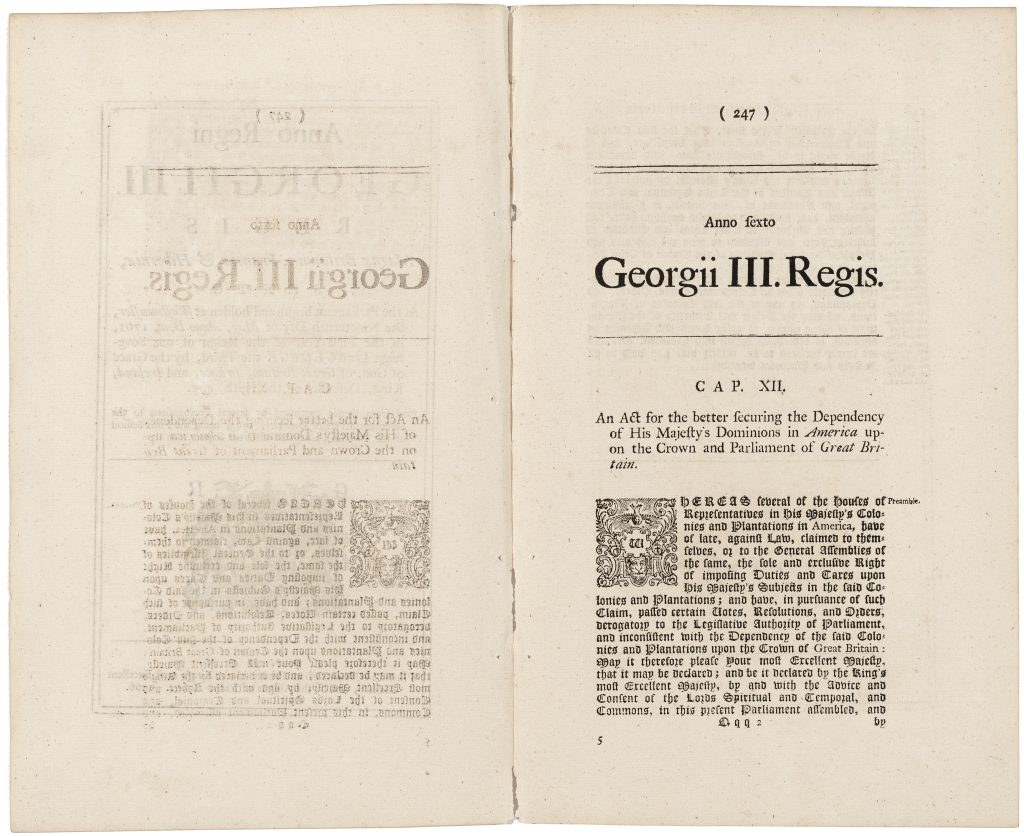
American radicals went far beyond argument to active resistance. Colonel Barre, in a famous speech in Parliament, praised American resisters as the “Sons of Liberty.” Under the leadership of Samuel Adams, extra-legal vigilante groups, now calling themselves “Sons of Liberty”, tarred and feathered stamp collectors and made them resign; they burned down stamp houses and rendered the distribution of stamped paper impossible. Now part of the pro-American minority in Parliament, William Pitt, the beloved wartime leader, publicly “rejoiced” that Americans had resisted.
At the same time that organized, limited, forceful American resistance made the Stamp Act unenforceable in fact, American legislatures also formally opposed it in Constitutional theory. Pennsylvania insisted the act violated “Constitutional rights and Principles of English liberty.” Maryland insisted the Stamp Act violated “Magna Carta, the Petition of Right and the Bill of Rights.” Massachusetts cited “essential” and “unalienable” rights “founded in Nature and common to Mankind.” But American Colonial legislatures mostly stayed silent about what should be done. New York’s Resolutions were ambiguous, declaring that its inhabitants “owe Obedience to all Acts of Parliament not inconsistent with the essential Rights and Liberties of Englishmen.”
False news had its influence when The Newport Mercury (Rhode Island) reported that Virginia, America’s leading colony, had formally “Resolved that the inhabitants of this colony, are not bound to yield obedience to any law whatever designed to impose any taxation other than the Laws of the General Assembly” (emph. added). Virginia, the newspaper claimed, had gone even further, resolving that “any person who shall by speaking or writing assert or maintain that any person other than the general assembly of this colony have any right or power to impose or lay any taxation on the people shall be deemed an enemy to this colony.” The Virginia freshman firebrand, Patrick Henry, had prepared these last two resolutions, but pocketed them when he saw he couldn’t get the votes.
Based on these false reports, only Rhode Island officially reached the highwater mark of nullification, formally resolving that “inhabitants of this colony are not bound to yield obedience” to the Stamp Act. The resolution “directed” officials simply to ignore the Act and assuring them that “this Assembly will indemnify all the Officers on Account of their conduct.”
The American colonies sent representatives to a hastily assembled Stamp Act Congress. Conservatives tried to control it and urged the duty to obey the law until Parliament could be convinced to repeal it. Radicals wanted to endorse resistance. In the end, the Congress issued an compromise document that insisted that subjects owe “all due Subordination” to Parliament while skirting the essential issue of what subordination was “due”, especially to legislation whose “manifest tendency” was “to subvert Rights and Liberties.” Finally, the Stamp Act Congress issued “a loyal and dutiful address” to the King and a “Humble Application” to Parliament to repeal the Act.
The Sons of Liberty also backed up their actions with words: Government originates with the consent of the people, the New London, Connecticut Sons declared. The People in their Constitution set limits to the lawful exercise of governmental authority. “Whenever those bounds are exceeded, the People of a right to reassume that Authority.” And they have a duty to oppose “by every lawful Means, the Execution of unconstitutional acts.” And “if they can in no other Way be relieved” to “reassume their natural rights.” Pure Locke. Or was it?
Locke had clearly justified revolution as a response to “a long train of abuses all tending the same way.” But he justified revolutionaries’ “appeal to heaven” outside the Constitutional order. The question remained, and he failed to really address it: Within a Constitutional order, short of revolution, who was to judge whether Constitutional limits had been seriously transgressed? A corollary question Locke also failed to address: Is there is any half-way right between full submission to a Constitutional Plan and revolution or rejection of it entirely? Can a group justly exert limited force not to overthrow a government but to prevent it from exercising unlawful power in isolated cases, while still maintaining allegiance to the plan itself? Can evasion or open and avowed nullification limited to a single piece of unconstitutional legislation be part of a continuing allegiance to the plan itself. And if so, short of revolution, who judges whether proper guarantees have so manifestly been violated as to warrant evasion or limited forcible resistance? This, a most essential but never fully resolved Constitutional question, still plagues America today, 260 years later.
 Father Anonymous
Leave a comment