
“The opposition they make to the Stamp Act is only the beginning of troubles,” warned Anti-Sejanus, the English hardliner who publicly resented the “ungrateful” American colonists’ resistance and repeatedly called for “rigorous” enforcement rather than repeal of the Stamp Tax. American opposition, he warned “is nothing but a prelude to the game that they intend to play.” How right he was.
Certainly American radicals intended and continued to escalate the pressure. But the logic of the repeal itself could not bear its own weight. The longstanding distinction between “internal” and “external” taxation could not ultimately be defended economically, much less constitutionally. Britain could just as easily impose a tax upon America by slapping tariffs on British imports, while restricting American exports. Call it a tariff, but if it functions to raise revenues in the Colonies without their legislative consent, it was taxation by another name.
That soon became obvious to all sides. Partly due to Benjamin Franklin’s witty and scripted public questioning before Parliament, many English hardliners believed Americans accepted the constitutional distinction between “internal and “direct” taxation vs “external, indirect tariffs” long since abandoned in America.
Soon after the Stamp Act confrontation ended, as Edmund Burke explained looking back three years later, “another spirit began to prevail: the spirit of taking advantage of the Americans, not through internal revenue but through commerce.” In a mood to reassert its authority over the ungrateful Americans, the new Administration intended to exploit the distinction between “internal” and “external” taxation, they wrongly believed the Americans still claimed. The famous Townshend Acts of 1767 imposed duties on staples such as paper, paint, glass, lead, and tea the American colonists could only legally import from England. The Townshend Acts as Burke observed, was “to serve as a test” whether the colonies would “recogni[ze] our right to tax them.”
Of course they would not. To make matters worse, from the American point of view, revenues raised by the Townshend Acts would pay salaries of Governors and judges, thus making them more dependent on London, and less on the local Colonial legislatures. John Dickinson’s Letters from a Farmer forever destroyed in American eyes any constitutional distinction between external and internal taxation. It denied Parliament’s right to tax, internally or externally. But Dickinson’s widely circulated essays, relatively moderate in tone, also acknowledged Parliament’s “unquestionable” constitutional right to regulate trade “for the common good of all.” “We are but parts of a whole: and therefore there must exist a power somewhere to preside and preserve the connexion in due order. This power is lodged in Parliament.”
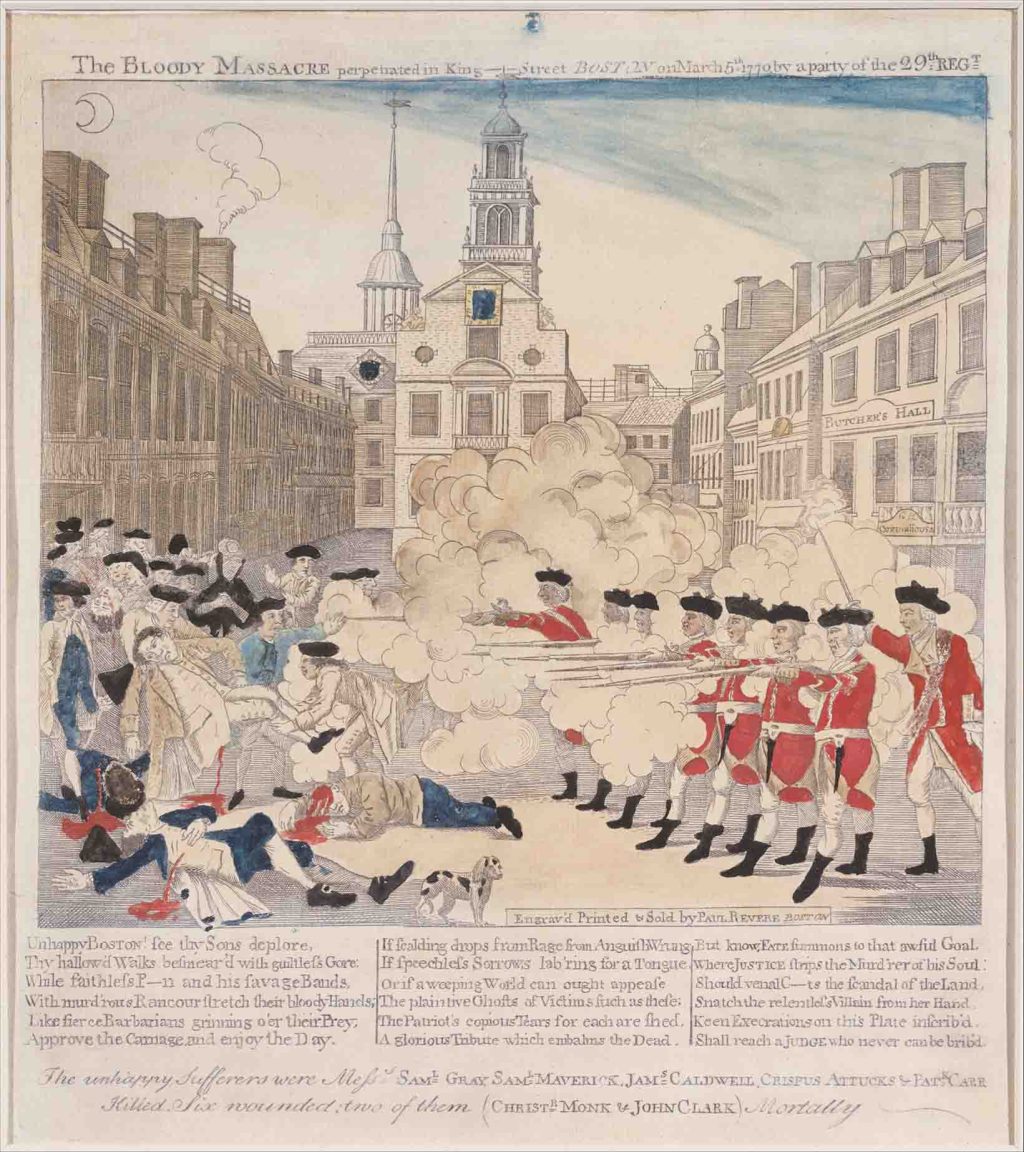
“Your bottom was rotten,” Burke warned his fellow members of Parliament. “The storm which had subsided [with] the repeal of the stamp act, was revived by this new measure.” And so it had been. Once again Boston led the colonial resistance, urging other colonies to join a general boycott of merchants who cooperated with the Townshend Acts. Mobs attacked customs officials and coerced them into resigning. Desperate to restore order and authority, the new Ministry sent British troops to occupy Boston. Bostonians now felt themselves occupied by a hostile power. Constant conflicts between townsmen and soldiers culminated in the “Boston Massacre” – so named by Samuel Adams.
False news once again played its key part. Widely circulating among the American colonies, Paul Revere’s famous poster of the deadly confrontation fundamentally distorted the tragic scene: In this depiction, engineered by Sam Adams, British soldiers calmly lined up to shoot defenseless Bostonians, their Captain behind them waving his sword, urging them on. In fact, a Boston mob pelted a small group of soldiers with ice balls and attacked them with clubs. Captain Preston, trying to quiet things and prevent bloodshed, bravely placed himself between his men and the attacking mob. As prominently part of the bloody scene, this best-selling propaganda depicted a fictitious building named “Butcher’s Hall.” And the blood of dead and dying Bostonians lying on the ground was carefully colored to exactly match the hue of the British “redcoats.” Once again, the power of consciously distorted reporting was on full display: The manipulated image became the reality and inflamed American resistance!
 Father Anonymous
Leave a comment